Why raised beds suit the Polish climate
Poland's continental climate — characterised by cold winters, late spring frosts and periodic summer droughts — creates specific challenges for ground-level vegetable growing. Raised beds address several of these directly:
- Elevated soil mass warms faster in spring, extending the growing season by two to four weeks in central and eastern Poland
- Drainage is improved regardless of underlying soil type, reducing the risk of waterlogging during the frequently wet April–May period
- Soil quality is fully controllable, which matters particularly in urban gardens where existing soil may be compacted, contaminated or heavily depleted
- The defined bed boundary makes crop rotation, companion planting and record-keeping more straightforward

A raised bed used for carrot growing, showing typical construction height — Wikimedia Commons (CC BY-SA 2.0)
Construction materials
The most common materials for raised bed frames in Polish gardens are untreated timber, scaffold boards, and galvanised metal panels. Each has trade-offs:
Untreated timber
Pine, larch and oak boards are widely available at timber merchants (tartak) across Poland. Larch and oak are naturally more rot-resistant; pine typically lasts five to eight years in direct soil contact before deterioration becomes structural. Avoid pressure-treated timber unless it is certified for food-growing contact, as older formulations contained compounds such as copper chromated arsenate (CCA) that should not enter food garden soil.
Scaffold boards
Thick scaffold boards (typically 38 mm × 225 mm) are a popular choice because the height of a single board creates a usable raised bed depth without additional construction. They are available from salvage suppliers and construction material resellers, often at low cost.
Galvanised steel panels
Corrugated galvanised steel panels are increasingly used in Polish gardens. They are durable, require no maintenance and do not rot. Some gardeners are concerned about zinc leaching from galvanised surfaces; current evidence does not indicate this poses a risk at levels harmful to plants or people in garden soils, but the debate continues in organic gardening communities.
Creosote-treated railway sleepers (podkłady kolejowe) are widely available in Poland but are not suitable for food gardens. Creosote is a classified carcinogen; EU Directive 2003/2/EC restricts its use in domestic applications.
Dimensions and placement
The standard width recommendation for raised beds is 1.0–1.2 metres, which allows a gardener to reach the centre from either side without stepping on the soil. Stepping on raised bed soil compacts it and reduces the drainage advantage of the elevated structure.
Length is limited by available space and convenience — most guides suggest 2–4 metres as a practical range. Height varies: 20–30 cm is sufficient for most annuals; 40–45 cm is better for root vegetables such as carrots and parsnips, which require deeper unobstructed soil. Deeper beds also retain heat better through cold nights in September and October.
Orientation in Poland should generally be north-to-south along the long axis. This ensures both sides of the bed receive roughly equal sunlight over the day and prevents tall crops on one end from shading the entire bed.
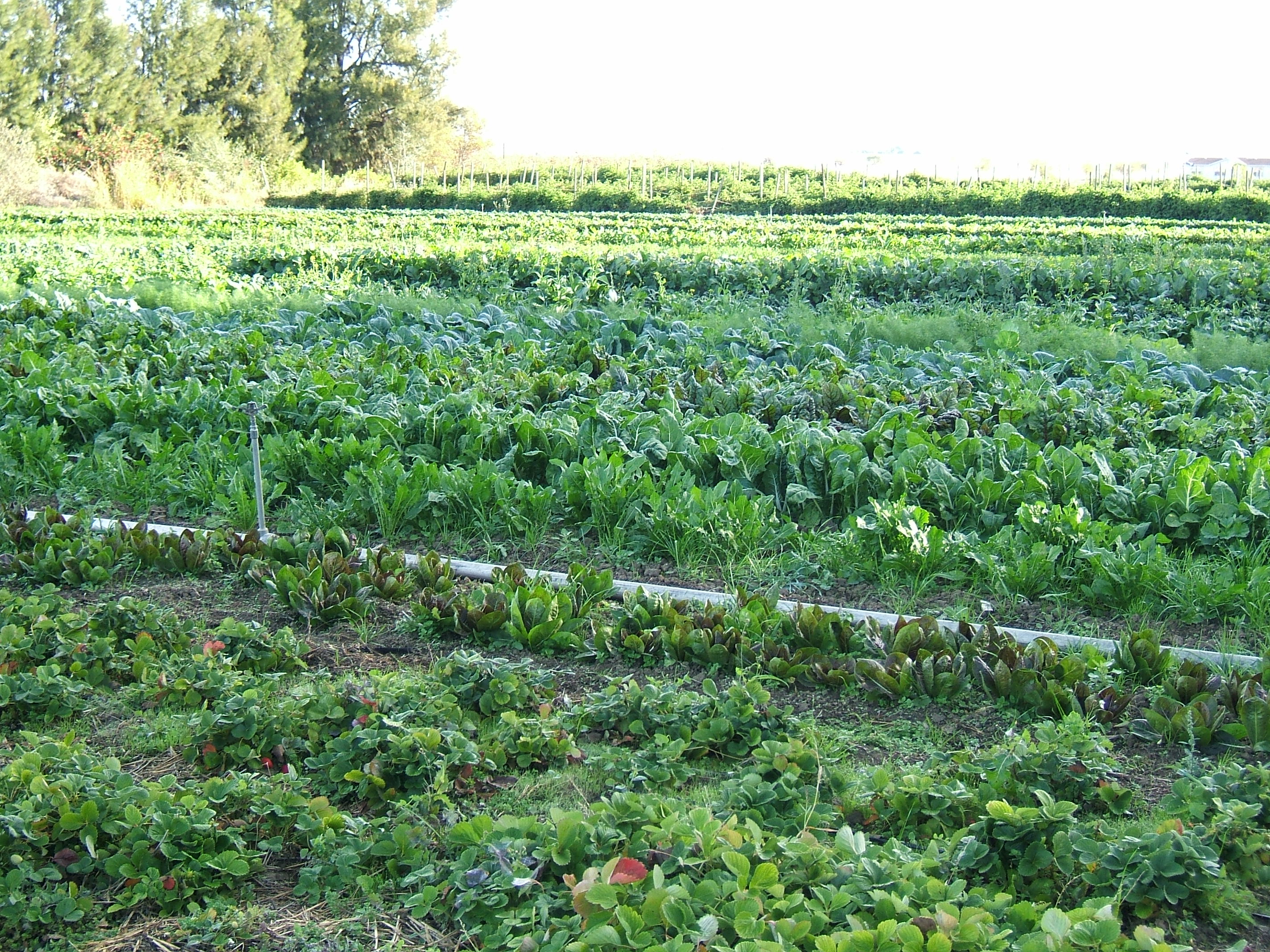
Organised vegetable beds in an organic farming context — Wikimedia Commons
Soil mix for raised beds
Filling a raised bed with soil directly from the garden typically produces poor results: the soil usually lacks organic matter, drains poorly and compacts quickly. A purpose-built mix performs significantly better.
A common starting mix used in Polish allotment practice:
- 50% quality topsoil (ziemia ogrodowa)
- 30% mature compost
- 20% coarse sand or perlite for drainage
The topsoil provides mineral content and volume; compost provides nutrients and microbial life; sand or perlite prevents compaction and improves drainage. In subsequent years, adding 5 cm of fresh compost to the surface each autumn maintains fertility without replacing the full mix.
Hugelkultur variant
A variant increasingly used in Polish permaculture gardens involves filling the lower half of a deep raised bed with rotting wood, branches and logs before topping with soil mix. The wood decomposes slowly, acting as a moisture reservoir during dry spells and releasing nutrients over several years. This technique is described in German-language literature as Hügelkultur and is particularly relevant for sandy-soil regions of Mazovia and Kujawy.
Frost management in spring
The average last frost date in Warsaw is around April 15–20, but late frosts occur in May in some years, and in northern and eastern Poland the risk extends further. Raised bed soil warms faster than ground level, but overnight temperatures can still damage seedlings.
Practical approaches include:
- Fleece (agrowłóknina) draped directly over plants provides approximately 2–3°C of frost protection and is widely available in Polish garden centres
- Mini polytunnels (low hoops with clear polythene) provide more protection and can be left in place longer, but require more management for ventilation on warm days
- Coldframes built at one end of a raised bed can start seedlings 4–6 weeks earlier than open ground
Watering raised beds
Raised beds drain more freely than ground-level soil, which is an advantage in wet springs but a disadvantage during the July–August dry period that affects most of Poland in most years. The elevated structure loses moisture faster, particularly in hot weather with strong winds (suche wiatry wschodnie) that affect eastern regions.
Mulching the soil surface with straw, wood chips or cut grass reduces evaporation significantly. In beds planted with taller crops, the plant canopy itself provides some shading of the soil once established. Drip lines or soaker hoses running along planting rows are the most water-efficient irrigation option.
Second-year management
After the first season, the soil volume in a raised bed will have settled by 10–15% as organic matter decomposes. Top up with compost before the new growing season. If soil feels compacted or drains poorly, surface aerate with a garden fork pushed in and gently levered without inverting the soil — this preserves the layered structure built up over the previous year.
External references: IFOAM Organics International · EU Organic Farming Regulation